
Why—Belief
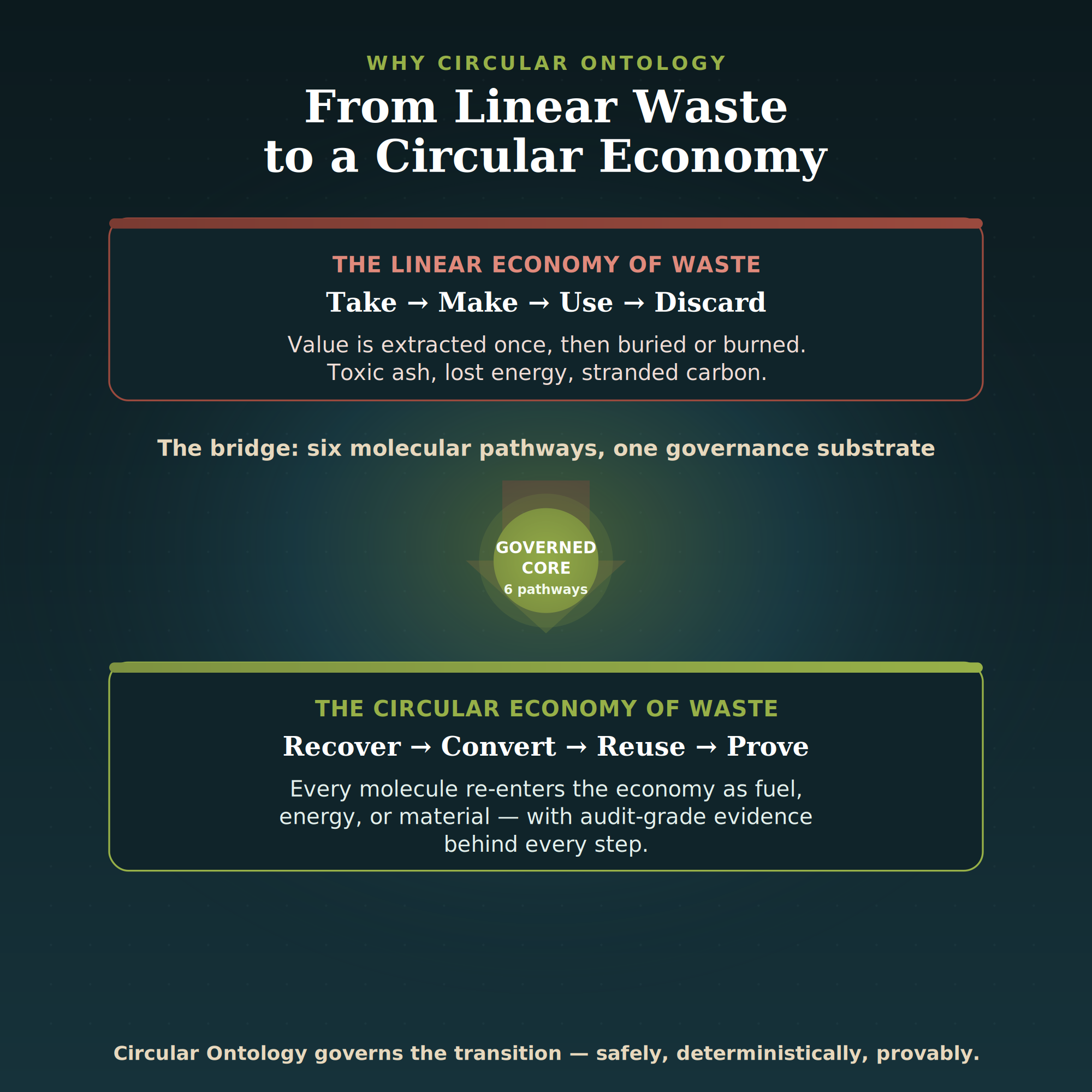
Nothing of value should be wasted.
We believe nothing of value should be thrown away — not a molecule, not a watt, not a moment of trust. The linear economy treats the physical world as disposable: take, make, use, discard. Value is extracted once, then buried or burned, leaving toxic ash, lost energy, and stranded carbon behind.
We reject that premise. The same conviction extends to autonomy itself: as machines begin to act on the physical world, the accountability for what they do should never be discarded either. A circular economy of matter is impossible without a circular economy of trust — every action recoverable, attributable, and provable.
Circular Ontology exists to make both real. We turn waste back into fuel, energy, and material, and we make the autonomous decisions that govern that transformation safe, auditable, and reversible. Deeply rooted. Elementally driven.
How—Differentiator
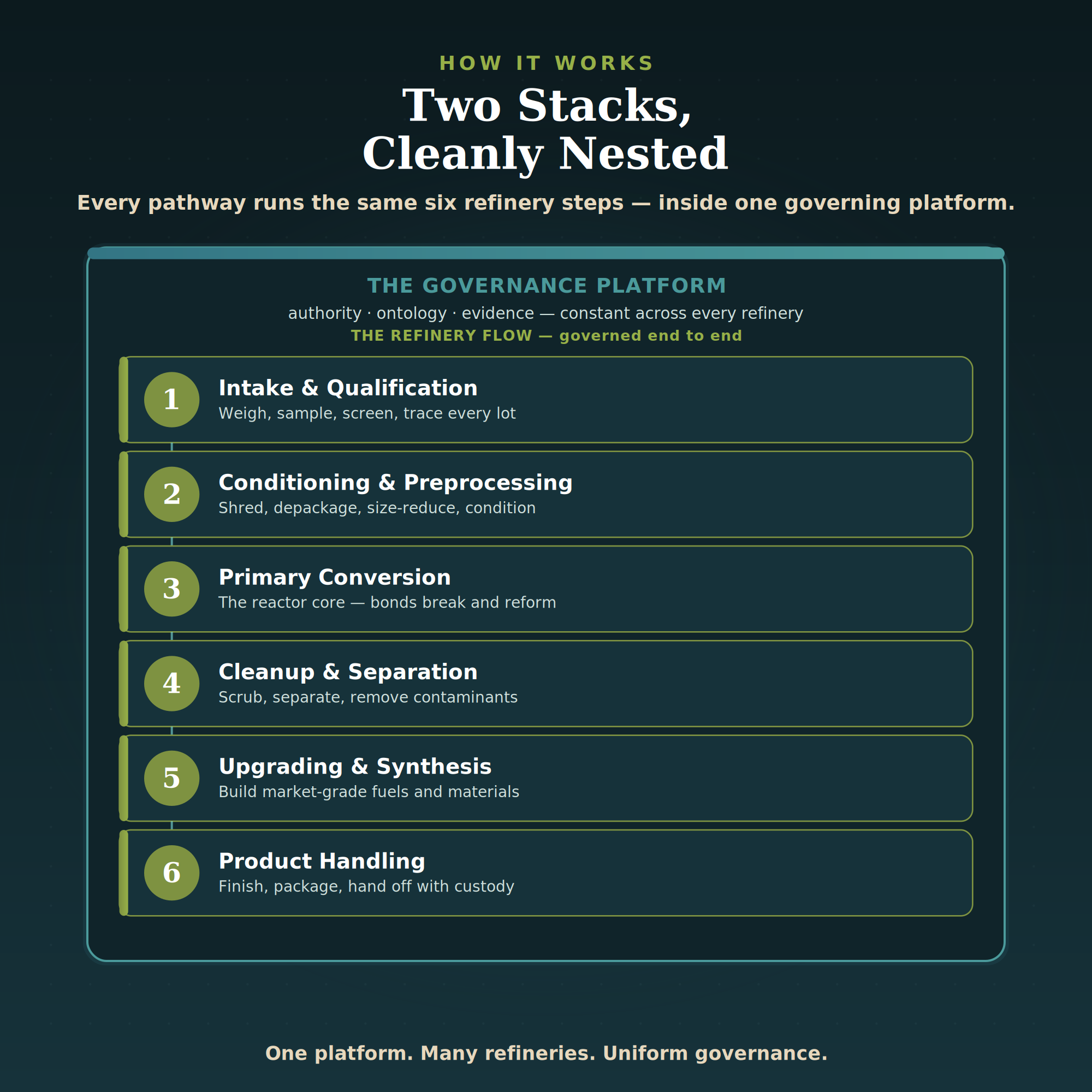
How it works. We govern, we don't replace.
Most technology asks you to rip out what you have. We don't. Circular Ontology is the deterministic control plane that sits above your systems — orchestrating the controllers, reactors, and vendors you already run, without ever touching the safety logic that keeps them safe.
That is possible because of how we're built: two stacks, cleanly nested. Every molecular refinery, whichever pathway it runs, follows the same six steps — intake, conditioning, conversion, cleanup, upgrading, product handling. Our governance platform wraps that flow end to end, holding authority, ontology, and evidence constant across every site. Probabilistic AI guesses; in operations running at thousands of degrees, a guess is a containment failure. So we don't generate decisions from learned distributions — we govern them from a canonical model, with machine-enforceable authority and tamper-evident evidence behind every action.
One platform. Many refineries. Uniform governance.
What — Proof
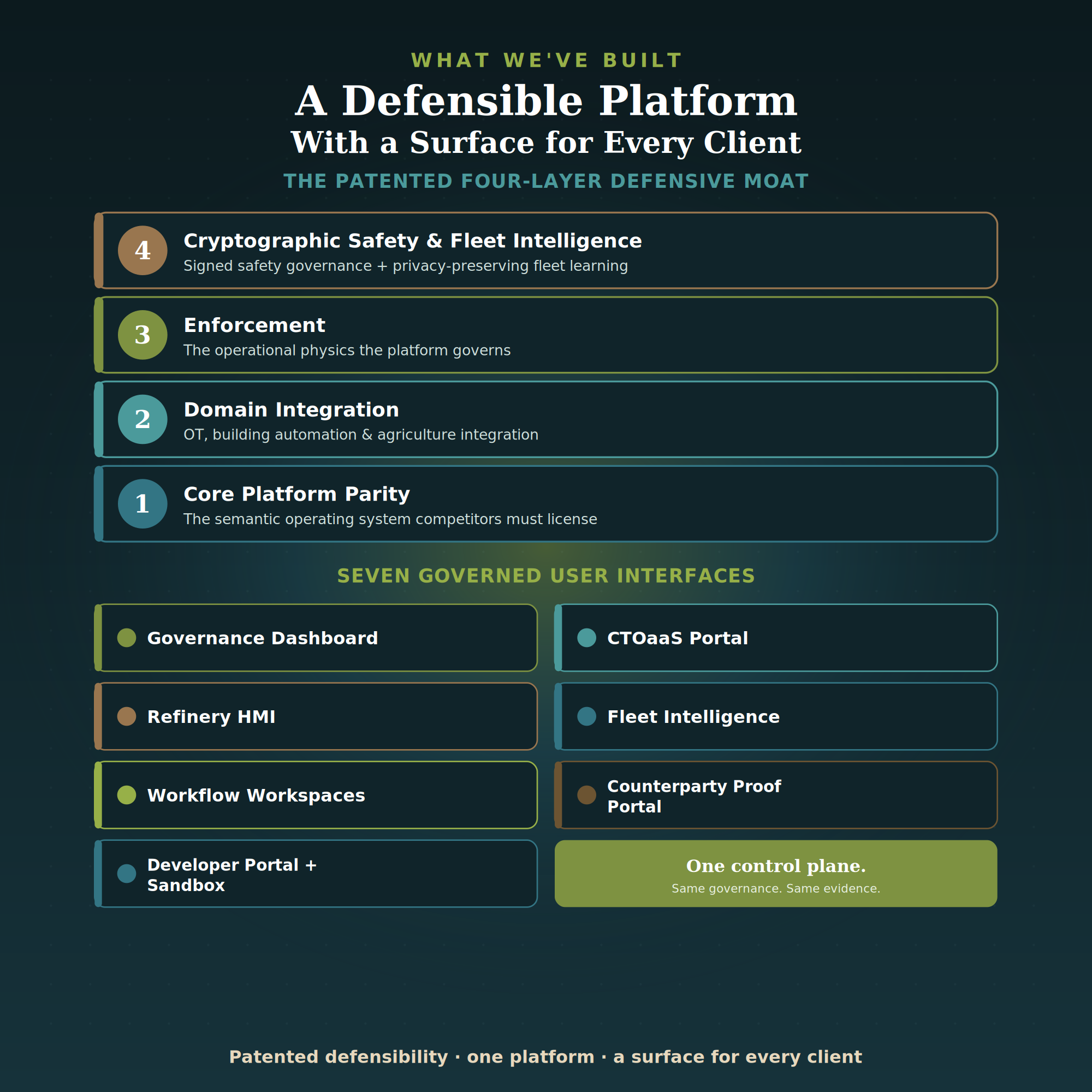
What we've built. A defensible platform, with a surface for every client.
The result is a category-defining control plane, protected by a patented four-layer defensive moat: core platform parity, domain integration, operational enforcement, and cryptographic safety with privacy-preserving fleet intelligence. Together they make Circular Ontology the layer competitors must license rather than rebuild.
And because governance only matters if people can use it, the platform meets every client where they work — through seven governed interfaces, from the refinery floor HMI and operations dashboard to the integrator portal, fleet benchmarks, workflow workspaces, counterparty proof portal, and developer sandbox. All seven sit on one control plane, sharing the same governance and the same evidence.
Patented defensibility. One platform. A surface for every client.
Contact us
Interested in working together? Fill out some info and we will be in touch shortly. We can’t wait to hear from you!